Not sure what something means?
View the Glossary →
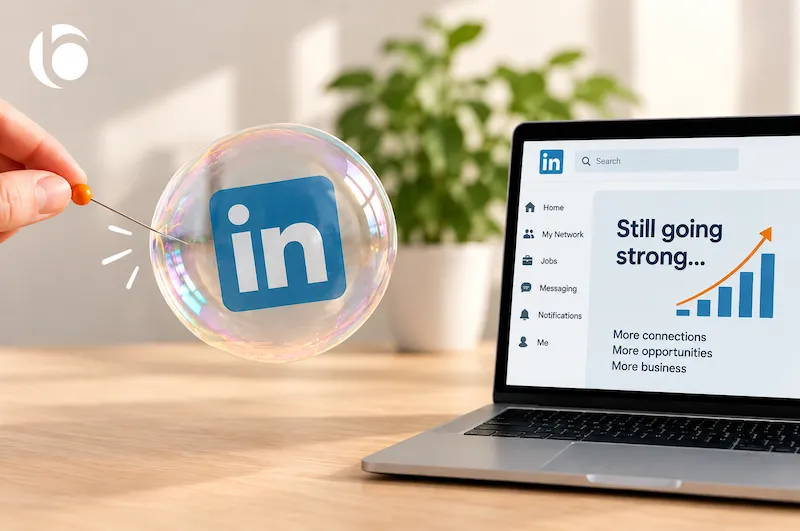
2026 update: I originally wrote this article in September 2015, when LinkedIn had around 350 million users and there were questions about its financial performance and long-term future.
I wondered whether the LinkedIn bubble might burst. Spoiler alert: it didn’t!
I’m leaving the original article largely as I wrote it because it’s an interesting snapshot of LinkedIn at the time – Google+ gets a mention too (remember that?)! Over a decade later, LinkedIn has become an even more important part of B2B marketing, and I now run a LinkedIn Lead-Building service for clients. So I think we know how my prediction turned out.
Here’s what I wrote back in 2015…
The most popular social network for business professionals – LinkedIn was launched on the stock market in 2011 and performed better than sales forecasts predicted, until now. Suffering losses of $43m for the second quarter of 2015 resulted in a share price drop of 25%. This begs the question, should we have concerns about LinkedIn’s future and as a business, should we continue to use LinkedIn as part of our social media portfolio?
What’s caused LinkedIn’s financial loss?
LinkedIn themselves believe their weaker financial position is a result of a strong US dollar and moreover, the costs associated with the purchase of the online learning business Lynda.com. LinkedIn announced it bought the Californian based online education company Lynda for £1.1bn last month. This is the company’s largest acquisition to date and naturally there will be short-term pressure on margins and an initial delay in building up revenue from such a big investment.
Marketing experts believe the restructuring of LinkedIn’s sales team had an effect on revenue, as did the weaker demand for traditional display advertising on the site. LinkedIn’s Chief Financial Officer Steve Sordello told investors ‘The shift in ad-buying habits caused a drop in demand for our traditional display products’.
Social media players comparisons
LinkedIn isn’t alone with recent shaky share prices. Several social media players made similar announcements
including Twitter making a loss of $162m causing the share price to tumble by 26%. At the same time Facebook enjoyed climbing revenues but saw profits fall (albeit minimal), with a comparatively small 5% drop in its stock price. Some experts say this indicates investors’ belief and faith in Facebook, perhaps not shown to LinkedIn. They argue it could also be a sign that advertising and social media is concentrated to the big players Facebook and Google+, which were considered must-buys for businesses because of the mass advertisers and consumers they continue to reach. According to Forrester Research, just 21% of adults in the US visit LinkedIn at least monthly, much lower than Facebook’s 70%. Yet is it fair to always compare against the huge bar and model that Facebook set and discount LinkedIn’s place in social media?
LinkedIn’s USPs
If we think about LinkedIn’s place in social media, where do they position themselves and what are their unique selling points?
1. It targets professionals and business networks
LinkedIn is different; they pride themselves on being a network for businesses, not leisure. They diversify by having numerous sources of revenue and they consistently update their offerings every year.
2. Biggest earner is not advertising
In the social-media industry, LinkedIn is somewhat of an anomaly because its biggest revenue source is not from advertising, it’s from the talent-solutions business which primarily serves corporate recruiters.
3. Lynda.com acquisition
The company is now entering online learning marketing with its purchase of Lynda.com; a leading website with an online library of video tutorials on topics such as business marketing tips, SEO and website design. This will boost the content it can offer its users with the aim of persuading them to spend more time on LinkedIn aside from searching for jobs and updating their CVs. The mission statements of both companies match in ‘striving to help professionals be better at what they do’ and this again differentiates them from other social media, targeting professionals and business networking. Buying Lynda.com is forecast to make $25 million full-year revenue so not only should their financial reports pick up, entering into online education makes a lot of sense for LinkedIn as it strengthens the reasons their existing and new users will visit, stay on and then pay to be on the site.
4. Increase in premium subscriptions
The above mentioned growing customer base as well as the increase in business and interaction with its existing 300 million users, will ultimately lead to an increase in subscriptions and subsequent revenues.
5. Expanding mobile presence
LinkedIn continues to develop its mobile capabilities, with the LinkedIn Job Search app launch for Android.
6. Strengthening and raising the number of jobs listings
To entice and offer value to both job seekers and employers visiting the site, job listings have been increasing rapidly: the figure rose from 2 million to 3 million in the last 6 months of 2014.
7. LinkedIn Elevate
New products continue to be launched. LinkedIn Elevate is a paid tool for business professionals to share links to articles, stories, presentations and blog posts across social media networks.
8. International expansion
LinkedIn continue to expand into newer geographies and push into growing markets like China.
The future of LinkedIn
Social media is a popular and current market with immense potential. There will be great champions (Facebook appear to be winning the race at the moment) however there is room out there for others that can differentiate and position themselves accurately. It’s not always right to generalise and compare social networking companies because Facebook is an apple, to LinkedIn’s orange, to Twitter’s grape. For us as businesses, it’s important to embrace all social media that is working. With over 350 million users globally, LinkedIn’s long-term growth potential stands confident and strong. They seem to be adopting strategies that are driving healthy growth in both the number of their users and users’ engagement. The purchase of Lynda.com gives them a presence in the online education market and should significantly add to their overall revenue so let’s see if their losses soon turn to profits and they remain a solid social media player for us to utilise for our own businesses.
So, did the bubble burst?
No. I think it’s safe to say I can answer my 2015 question now!
LinkedIn has changed a lot since I wrote this article, but what interested me about it then is still what makes it useful now – it’s a network built around professional relationships.
That’s also why I don’t think LinkedIn works particularly well when businesses treat it as somewhere to fire sales messages at as many people as possible.
I use it to help clients identify and connect with relevant people, start genuine conversations and build relationships that can lead to enquiries, meetings and referrals over time.
Take a look at my LinkedIn Lead-Building service if you’d like to see how I use it to help businesses make new connections.
If you find my articles useful, add Belluber as a preferred source on Google to see more of my website and marketing advice in Google Search.
continue reading