
Not sure what something means?
View the Glossary →
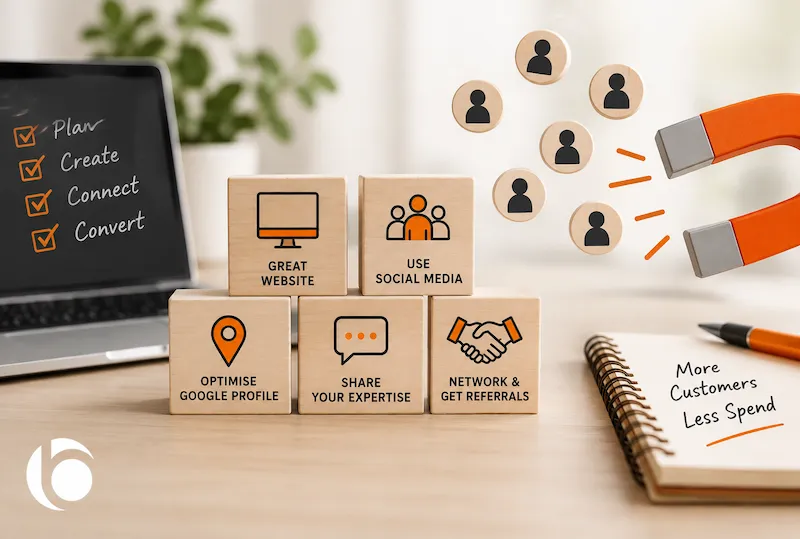
Marketing your business doesn’t have to mean spending a small fortune on advertising.
Some of the best ways to attract potential customers are about making better use of things you already have – your website, your knowledge, your existing customers and the contacts you’ve already got.
I originally wrote this article in 2014 and called it “5 ways to attract potential customers in 2014 with no cost”. I’m changing that slightly because (apart from it not being 2014), very little marketing is completely free. If something takes three hours of your time, there’s still a cost involved.
But there are lots of ways to improve your marketing without increasing your budget.
1. Have a bloody good website
Yes, I’m keeping that heading from the original article!
Your website is often one of the first places somebody goes after hearing about your business. They might have found you through Google, seen something you’ve posted on LinkedIn, been given your name by somebody else or met you at an event.
Whatever brought them there, your site needs to quickly answer some basic questions:
- What do you do?
- Is it relevant to me?
- Why should I choose you?
- Can I see proof that you’re good at it?
- What do I do next?
Have a look at your own homepage and imagine you’ve never seen it before. Is all of that obvious?
Make sure your website is easy to use on a phone too. If somebody has to pinch, zoom and perform more finger gymnastics than Fingerbobs (showing my age there!) just to find your telephone number, you’ve made contacting you too hard.
Low-cost tip: Before paying for a complete redesign, look at what you can improve on the website you already have. Better wording, clearer calls to action, updated examples of your work and stronger customer reviews can all make a difference.
2. Share what you know
Useful content gives potential customers another way to discover your business – and just as importantly, a reason to trust that you know what you’re talking about.
You don’t have to sit down every Friday and think, “I’d better write a blog post”. Start with the questions customers already ask you. I’ve done quick searches my emails for questions clients have asked me. I found quite a few interesting questions I answered! One was from a client’s PA who asked: Do you think creating the LinkedIn event on Martin’s profile is worthwhile, or should we be sending people directly to the Eventbrite website instead?
I’ll be writing a short blog post (or LinkedIn post) about whether adding your events on LinkedIn are better than just linking to another website from your posts.
You could create:
- answers to common questions
- helpful checklists
- how-to articles
- case studies
- comparisons
- tips based on your experience
- explanations of things customers often find confusing
One good article can give you material for your social media and email marketing too.
Useful content can also help your search visibility. Google and AI search tools need useful info to understand what businesses know about and which sources might help answer someone’s question.
That doesn’t mean stuffing articles with keywords or producing hundreds of generic AI-written posts. Share something genuinely useful that shows off what you know.
3. Keep in touch with people who already know you
Not everybody who comes across your business is ready to buy straightaway. Someone might make an enquiry and decide the timing isn’t right. They might download something from your website, meet you at an event or have a chat with you on LinkedIn.
Don’t automatically forget about them. With the appropriate permission, email marketing can be a useful way to keep in touch with people who are interested in your business. Share useful advice, company news, events, new services or special offers rather than emailing people only when you want to sell them something.
Your existing customers matter too. Staying in touch can lead to repeat work, additional services and referrals.
Low-cost tip: You don’t necessarily need an expensive CRM or marketing platform. Choose software based on what you actually need rather than paying for dozens of features you’ll never use. I had a client who was about to buy a fully-featured CRM database system – when he just wanted to send out email newsletters to a small list of clients. I advised him against it and explained what he could do instead. This saved him over £1k in just one year (plus the time he’d have had to put in to learning the CRM system).
4. Make more of your happy customers
Your existing customers can be one of your best marketing channels. Reviews, testimonials, referrals and recommendations are things that are difficult to create yourself – independent proof that you’re good at what you do. So ask!
If somebody tells you they’re delighted with your work, that’s a pretty good moment to ask if they’d mind leaving a review.
Make it easy by sending them a direct link to the place you’d most like the review, such as your Google Business Profile.
It’s worth knowing that Google’s current Business Profile policy says merchants must not offer incentives such as payment, discounts, free goods or services in exchange for reviews.
You can also turn particularly useful feedback into testimonials on your website – with the customer’s permission.
Don’t overlook referrals. A happy customer may know exactly the sort of person or business you’d like to work with next.
Low-cost tip: Give people something worth talking about. Respond quickly, be helpful, communicate properly and sometimes do that little bit more than they expected. Memorable customer service is marketing too.
5. Keep your marketing clear and free of nonsense
This was number five when I originally wrote this article and I haven’t changed my mind.
People are bombarded with information. Your potential customers don’t have unlimited time to work out vague marketing language and work out what you’re actually trying to tell them.
Keep it straightforward. Explain what you do, who you help and why it matters in language your customers actually use.
Try reading some of your website copy out loud. If you’d never say it to a customer in real life, ask yourself why you’ve written it on your website.
And be suspicious of sentences containing phrases such as “innovative solutions”, “leveraging synergies” or anything else that sounds impressive but doesn’t actually tell the reader anything. Clear beats clever surprisingly often.
One more thing – don’t try to do everything
There are now more ways to market a business than there were when I originally wrote this article. That doesn’t mean you need to use all of them.
If your customers aren’t on a specific social platform, you don’t need to be there just because everybody keeps talking about it.
If an expensive piece of marketing software gives you features you’ll never use, find something simpler.
If something you’ve been doing for months isn’t producing anything useful, review it rather than blindly carry on with it.
I can help you work out where to focus your marketing
I help businesses decide which marketing activities are worth concentrating on – and which probably aren’t worth their time or money.
Take a look at my Digital Marketing service or get in touch if you’d like to talk through what you’re currently doing and where there might be ways to improve it.
If you find my articles useful, add Belluber as a preferred source on Google to see more of my website and marketing advice in Google Search.
continue reading


