

Not sure what something means?
View the Glossary →
How much do you know about your competitors?
I’m not suggesting you should spend hours watching everything they do or change your business every time one of them launches something new, but I do think it’s useful to have a look at them from time to time – especially at the businesses your potential customers are likely to find when they’re looking for the products or services you provide.
Before somebody contacts you, there’s a good chance they’ll look at several other businesses too.
What do those businesses offer? What do they say about themselves? How easy are they to find on Google? What do their customers say about them? Is there anything you could be doing better?
Start by working out who your competitors are
The businesses you think of as your competitors aren’t necessarily the only ones your potential customers are comparing you with.
Try searching Google for the products or services you provide, using the sort of words a potential customer might type rather than just your own business terminology.
For a local business, add the area too.
Have a look at who appears in the normal search results, the map results and any other prominent results. You might find businesses you hadn’t really considered as competitors before.
I’d also look elsewhere – not just in Google results. Who keeps appearing on LinkedIn? Who has a strong presence on Instagram or Facebook if those platforms are relevant to your market? Who seems to be talked about or recommended?
You don’t need a list of 50 businesses. Choose a handful that are genuinely competing for the sort of customers you want.
Look at their websites as a potential customer
Don’t just look at whether you like the design. Imagine you know nothing about the business and have arrived on the website for the first time.
Can you immediately understand what they do and who they help? Are their services easy to find? Do they explain why somebody should choose them? Are there clear prices or packages? Do they show examples of their work? Is it obvious what to do next?
Then compare that experience with your own website.
It’s very easy to become so familiar with your own website that you stop noticing things a new visitor might find confusing or unconvincing.
Look at how they position themselves
Two businesses can provide almost exactly the same service but present themselves very differently.
One might compete on price, another might emphasise experience and somebody else might specialise in a particular industry, type of customer or location.
Look at the messages your competitors repeat throughout their websites and marketing. What reasons do they give people to choose them?
Then think about your own business. Are the things that make you different obvious?
When I redesigned the Belluber website, this was something I thought about a lot. I wanted it to be much clearer that clients are dealing directly with me rather than a large agency, that I’m not just starting – I have more than 25 years’ experience and that being responsive and giving clients control of their websites are important parts of the service.
Those aren’t things I invented because competitors weren’t saying them. They’re genuine differences in how I work. Looking at the market helps you work out which of your own strengths you should be making more of.
See which services they’re promoting
Have your competitors added services you don’t offer? Are several of them pushing a particular service heavily? Have they packaged services differently? That doesn’t automatically mean you should do the same, but it can tell you something about what’s happening in your market and could give you some ideas.
You might also spot the opposite – something customers need that very few competitors appear to be talking about. That could be an opportunity for you.
Look at their Google visibility
Search for some of the terms you’d like your own business to be found for and see who keeps appearing.
Look at the pages Google is showing. Are they service pages, location pages, blog articles, guides or something else?
Have a look at their Google Business Profiles too if they’re local competitors. How complete are they? How many reviews do they have? Are there recent photographs and useful information?
Read their reviews
This is one of my favourite parts of competitor research because customers will often tell you what matters to them. Don’t just look at how many stars a competitor has. Read what people actually say.
If reviews repeatedly mention that somebody is quick to respond, explains things clearly, is reliable or makes something easy, those are clues about what customers value when choosing that type of business.
Negative reviews can be useful too. If people repeatedly complain about poor communication, delays or unexpected costs across your industry, think about how you could reassure potential customers that they’ll have a different experience with you.
That’s much more useful than adding a generic line to your website saying you provide “excellent customer service”.
Look at what content they’re creating
Have a look at competitors’ blogs, news pages, FAQs, newsletters and social media.
What subjects do they talk about? Which customer questions are they answering? Are there subjects everybody seems to ignore?
Again, don’t copy their articles or start producing content just because they do. Use it to identify gaps. You might find some useful questions your own customers regularly ask that nobody else is answering very well. Those could become FAQs, articles, videos or social media posts of your own.
Have a look at their social media – but don’t get distracted by numbers
A competitor having more followers than you doesn’t mean their marketing is more successful. Look at what they’re actually doing. Which platforms do they concentrate on? What sort of content gets comments or genuine conversations going? Do they show their work, their people and their expertise or mostly post promotional graphics?
Compare the customer experience
Competitor analysis doesn’t have to stop at marketing. Think about what happens when somebody decides to contact the business. Is it easy to make an enquiry? Can they book a call online? Is there useful information about what happens next? Are prices explained? Are common concerns answered before somebody has to ask? Sometimes small things make a business much easier to buy from.
When you’re reviewing competitors, make a note of anything that makes you think, “That’s useful.” Then think about how you could improve your own customer experience – not how you can copy theirs.
Don’t automatically compete on price
It’s tempting to find out what competitors charge and worry if somebody is cheaper. There will nearly always be somebody prepared to do something for less.
Price is useful information, where it’s publicly available, but look at what customers are getting for that price too. Are the services genuinely comparable? Is one aimed at a completely different type of customer?
If you’re more expensive, the important question is whether potential customers can see why.
AI can help with competitor research too
AI can make some parts of competitor research quicker. You can use it to help compare website messaging, summarise reviews or organise your findings, but I’d still look at the competitors yourself.
AI can miss context and it can make assumptions, particularly if you ask a vague question such as “Who are my competitors and what are they doing better than me?”
Give it the actual information you want it to analyse and then use its suggestions as a starting point rather than assuming everything it tells you is correct.
What should you actually do with all this information?
This is the important bit. There’s not much point spending an afternoon researching competitors and ending up with a huge document you never look at again. Make a list of what you’ve learnt and turn it into actions.
You might decide to:
- make your reasons for choosing you more obvious
- improve a service page on your website
- ask more customers for Google reviews
- create content around questions competitors aren’t answering
- improve your Google Business Profile
- make it easier for people to contact or book with you
- promote a service that isn’t currently getting enough attention
- make better use of testimonials or case studies
I’d prioritise the things that could genuinely make a difference rather than trying to match everything your competitors are doing.
Then do it again!
A competitor analysis isn’t something you need to do every week, but your market won’t stand still. New competitors appear, existing ones change direction, customer expectations change and Google search results don’t stay the same.
It’s worth having another look every now and then, particularly if you’re reviewing your marketing, redesigning your website, launching a new service or wondering why enquiries have changed.
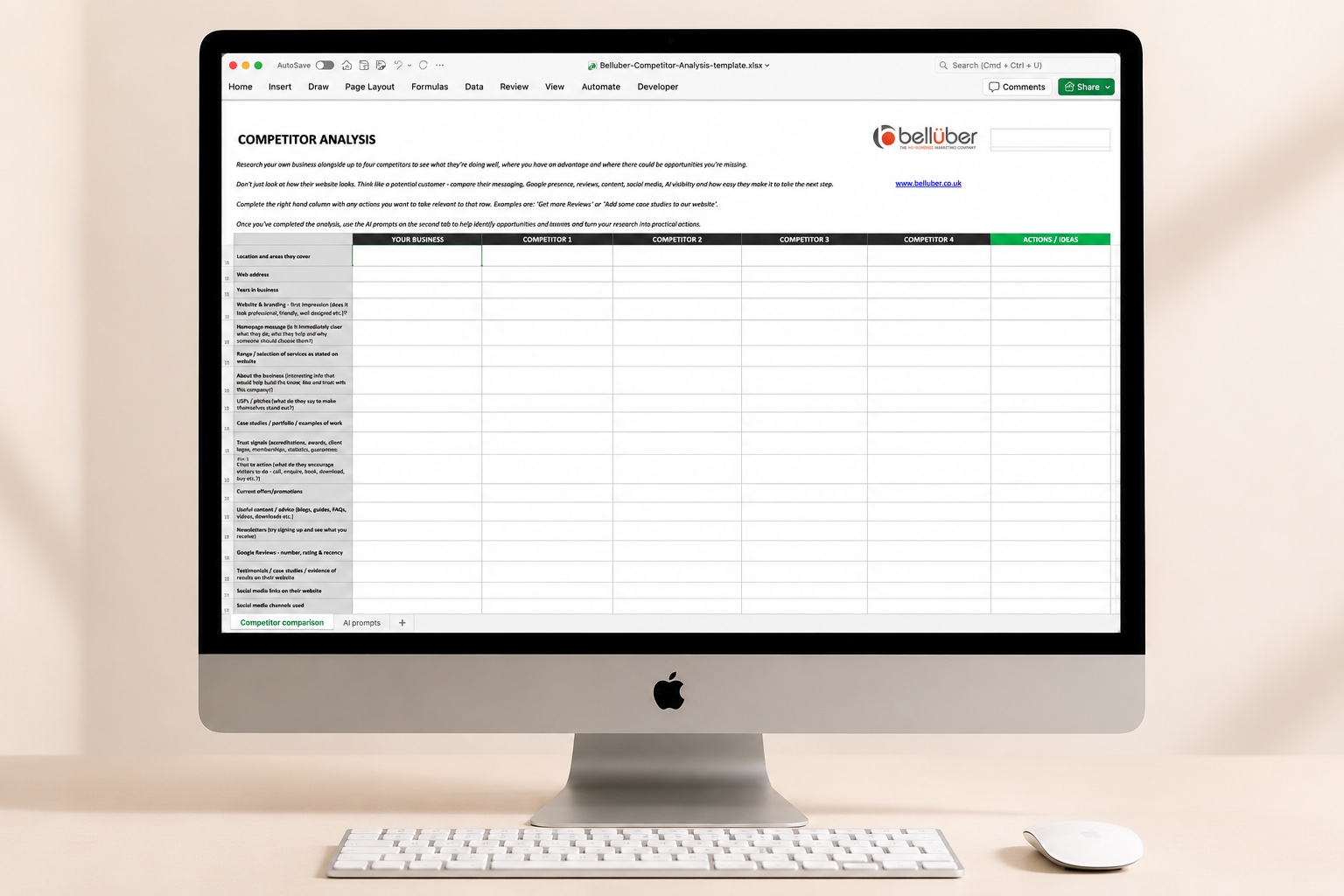 If you need somewhere to keep track of it all, I’ve created a free Competitor Analysis Template to help you research and compare your competitors.
It gives you a structure for looking at the things that actually matter and recording what you’ve learnt, including their website, services, positioning, Google presence, reviews, content and social media.
Don’t forget to use what you find out to think about your own business. The aim isn’t to become more like your competitors – it’s to understand what your potential customers are seeing and work out where you could do things better.
If you find my articles useful, add Belluber as a preferred source on Google to see more of my website and marketing advice in Google Search.
continue reading


